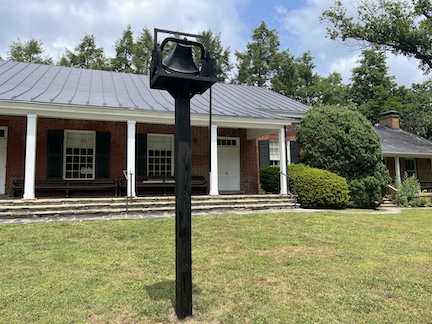
A farm bell made at the Taylor Foundry in the 1870s has been placed on the lawn in front of the Goose Creek meeting house. Allen Cochran rang it for the first time at its new location on July 4, 2026, to celebrate the 250th anniversary of the Declaration of Independence.
Richard Henry Taylor, a son of Yardley and Hannah Taylor, ran a foundry on what is now Foundry Road, near Lincoln. The Taylor foundry was active during the 1870’s. It made plows, farm bells, and smaller household items. Through a generous donation from Mrs. Kacey Jones, of Winchester, one of the Taylor Foundry farm bells has come back to Lincoln. Kacey said the bell, which she inherited from her grandfather, sat in her garage for decades. She decided it was time for the bell “to come home.”
Kacey is the grand-daughter of Harold Smith who lived in Purcellville and ran a dairy. Harold Smith was a son of John Russell Smith (1844-1906) and Mary Virginia Smith (1864-1952). The Smiths attended Goose Creek Meeting. John and Mary Smith farmed outside Lincoln, probably near other Smith farms located along Lincoln Road, near the sharp turn connected with Forest Mills Road.
John Russell Smith’s occupation on 19th century censuses is “farmer.” He lived at the time the Taylor Foundry was active; it is likely he purchased the Taylor bell now donated to Meeting. One side of the bell is cast with the words “Lincoln, Va” and on the other side is “R.H. Taylor & Son”
Asa Moore and Werner Janney’s memoir, “Ye Meeting Hous Smal” records (page 36) that Taylor foundry “farm bells pealed out sweet music to many a farmer’s ears at noontime. You used to hear them all over the place and they were in demand at country auctions too.”
Arthur K. Taylor, a son of Richard Henry Taylor, wrote a pamphlet about his family’s foundry, called “A Minor Industry.” He wrote that foundry employees went around in a wagon picking up scrap iron and metal left over from the Civil War. They collected hardware from barns and farm tools that had been burned by Union soldiers during the “Burning Raid” of 1864, plus iron from broken down Union army wagons, and even cannon balls!
The iron was used to make bells and plows at the foundry. It is interesting to think that the bell donated to us might be made of iron recycled from neighboring barns and wagons. When Civil War metal and local iron ran out, the Taylors began buying pig iron hauled into Berlin (Brunswick), Maryland by train.
— Lee Lawrence